
Theory of !resonances. Analog LLM.
Contact us.
e-mail:
  info@trallm.io

HOME             THEORY OF !RESONANCES               aLLM                                   


 Main
Theory of !resonances
TRIZ
aLLM

t!r Definitions
Resonances and synchronicity
External synchronization
Slots and i!l harmonics
!fluctuation
Le Chatelier
!Nonlinear bifurcation
!event flows
!flow !marker
!Cycle 3

Site News
aLLM beta testing.


Theory of !resonances is an active management framework that transforms
reactive response to the event flow into its predictive analysis and proactive regulation.

Theory of !resonances

The Theory of !resonances is a paradigm that allows us to look at the surrounding reality through the lens of cyclicity and the repeatability of event patterns. The exclamation mark "!" before the terms of the Theory of !resonances (t!r) clearly separates the system operator !resonance from the common physical term resonance, which denotes an increase in oscillation amplitude when frequencies match.

In essence, the Theory of !resonances represents a practical set of tools (a framework). It enables you to:
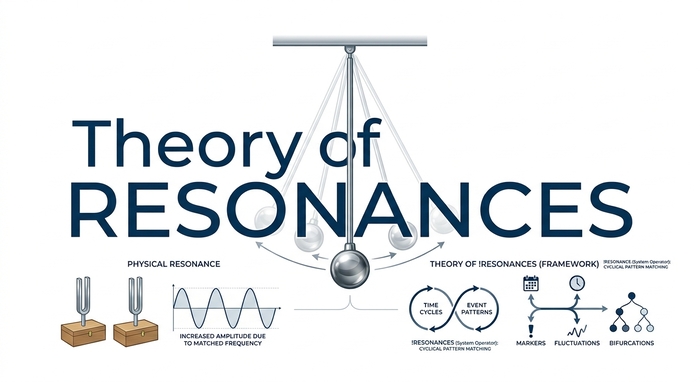
  • Navigate cyclic time and identify stable event patterns (!markers).

  • Work with !fluctuations—physical interactions with the external environment.

  • Analyze nonlinear !bifurcations—tipping points and multi-variability in system development.

  • Apply auxiliary techniques for self-regulation and managing hormonal levels in crisis situations.

About the project and participating in the development of t!r

This resource presents key theses and basic tools of the Theory of !resonances (t!r), designed for an initial introduction to the concept.

Since t!r is a dynamically evolving framework, we are open to dialogue and gratefully accept community contributions:

  • Development of the concept: You can take part in refining the methodology by submitting your proposals, constructive criticism, or observed patterns.

  • Practical application: Our team conducts individual consultations on integrating t!r methods into specific life, business, and crisis situations.

  • Research exchange: Send us your case studies and recorded !markers—the most interesting observations will be included in the shared knowledge base.

How to contact us? Write to us at info@trallm.io to ask a question regarding the practical application of the framework or to suggest a topic for joint research.


t!r Tools

  Tools for !fluctuations
   Shift of !nonlinear bifurcation
  Fractality, cascades
   IFR according to TRIZ
  Working with what is
  !Entanglement
  Crisis as an evolutionary mechanism
  !Incoming
  !Outgoing
 

  Endocrine system
  Working with the endocrine system
Insight
  Dopamine +/-
  Acetylcholine +/-
  Adrenaline / noradrenaline
  Nothing to do
Abandon project
  Minimalism