|
|
|
Theory of !resonances is an active management framework that transforms |
reactive response to the event flow into its predictive analysis and proactive regulation.
|
Le Chatelier's Principle Inside a !Fluctuation Slot
Previously, we examined cascades of !fluctuations and their visualization via the Feigenbaum diagram. Now, let us break down in detail what occurs inside a !time slot at the moment of direct exposure to a !fluctuation.
!Time slots are synchronized along the core chain: !Libration (gravitational surge) → Biological level → Neurophysiological level → Social impulse.
Let us examine this process using an
individual as an example (for organizations, the mechanisms are
identical but involve groups of people).
At the !libration point, an individual is simultaneously subjected to two types of exposure:
-
Internal (endocrine): A shift in the neurotransmitter balance and a change in psycho-emotional state (aggression, apathy, optimism, pessimism).
-
External (environmental): Direct exposure to the event !flow (!fluctuation).
The "Reality as an Analog LLM" Model
Let us imagine the system within the
"Reality is a large analog LLM" paradigm: the individual acts as
individual tokens, and events act as !incoming transactions.
Problem Scenario
An individual experiences a drop in acetylcholine levels (!ach-), causing fatigue and pessimism. At that exact moment, the external environment delivers a !fluctuational strike — a sharp rise in the incoming flow of tasks requiring immediate reaction.
-
Reactive scenario (default pattern):
The individual produces an
automatic reaction — fear, depression (turns off the phone, fails
work), or aggression (amplifies the negative impulse and passes it
forward). Since the slot pattern is cyclical, the individual regularly
falls into this loop. The analog LLM executes its habitual algorithm.
-
Proactive scenario (t!r tools):
The individual analyzes the !time slot database and determines which patterns are expected. For instance, at the intersection of !flows,
8 patterns are identified; based on dynamics, it becomes clear which
one dominates. By studying past records and the outcomes of former
decisions, the individual consciously selects a new tactic.
Shift of !Nonlinear Bifurcation and the Le Chatelier Effect
Suppose the individual chooses the tactic of shifting the !nonlinear bifurcation (!nb) — consciously stopping the impulse and refraining from passing the negative transaction forward.
-
Transaction delay:
Colleagues are accustomed to a specific type of reaction, but the
individual alters the behavioral pattern. The transaction arrives at
the token and "hangs."
-
Growing environmental pressure:
The analog LLM strives to complete the generation chain and begins
building up pressure on the token to force out the standard response.
-
Le Chatelier's Principle: In t!r,
this surge of environmental resistance is called the Le Chatelier
effect (by analogy with the physicochemical principle of equilibrium
displacement). The system, when faced with the element's proactive
resistance, reorganizes itself and temporarily amplifies external
pressure.
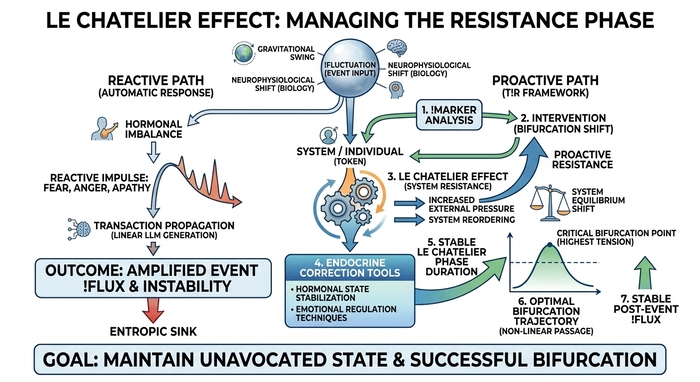
The Le Chatelier Phase and Working with the Endocrine System
The Le Chatelier phase is the key and most prolonged stage of working with an !incoming !fluctuation. During this period, the intense pressure of the event !flow, superimposed on hormonal background shifts, exerts a significant psychological burden on the individual.
To maintain stability, the theory of !resonances utilizes a number of auxiliary self-regulation tools:
-
Endocrine state correction: Application of specialized techniques to stabilize the neurotransmitter balance.
-
Reduction of emotional noise: Suppressing reactive impulses (aggression, fear, apathy) prior to making balanced decisions.
-
Smooth navigation of the phase: Maintaining the resource for comfortable operation under conditions of elevated external environmental pressure.
Main Goal of the Le Chatelier Phase
Calm and balanced operation at this
stage allows the individual to avoid making a critical mistake at the
peak tension point of the system — the point of !nonlinear bifurcation.
|
|