Contact us.
e-mail: info@trallm.io
|
|
|
Theory of !resonances. Analog LLM. Contact us. e-mail: info@trallm.io |
|
External synchronization in the social environment operates along a chain: !libration (gravitational surge) → biological level → neurophysiological level → social synchronizing impulse. This process forms a stable !resonance — regularly repeating behavioral patterns of individuals and social groups. Life examples:
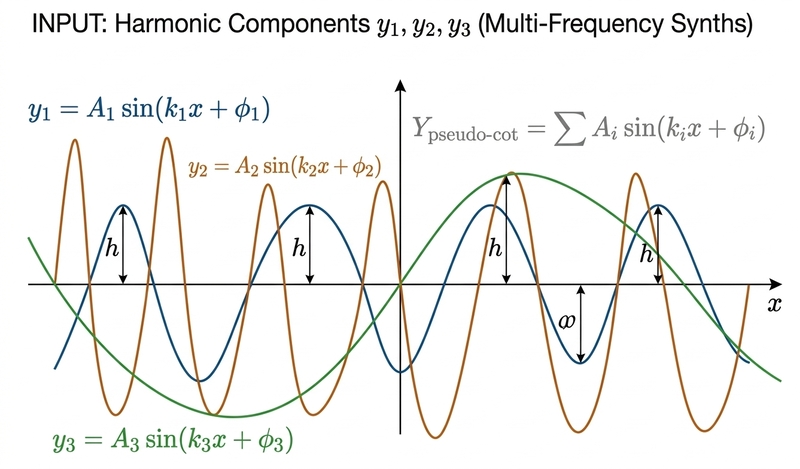
When an event repeats with a certain periodicity, the theory of !resonances designates it as an event !flow. At any given time, more than 10 major external synchronizations are active, creating interference interactions and harmonic oscillations:
Event Interference and AntinodesSince there are many such !flows and each has its own frequency, their overlap (addition of frequencies) occurs at certain moments. This leads to the emergence of event antinodes (surges of activity) and quiet zones. In everyday speech, these phases are often described by phrases:
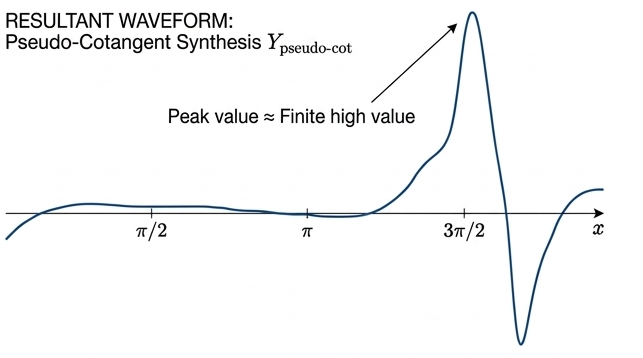
At peak moments, a multitude of physical interactions (!fluctuations in the terminology of the theory of !resonances) take place. In zones of calm, on the contrary, an extremely low number of interactions is recorded. Each event !flow possesses its own signature — a set of repeating patterns designated in the theory of !resonances as a !flow !marker. Forecasting Flow ActivityThe toolkit of the theory of !resonances allows for active work with !time slots:
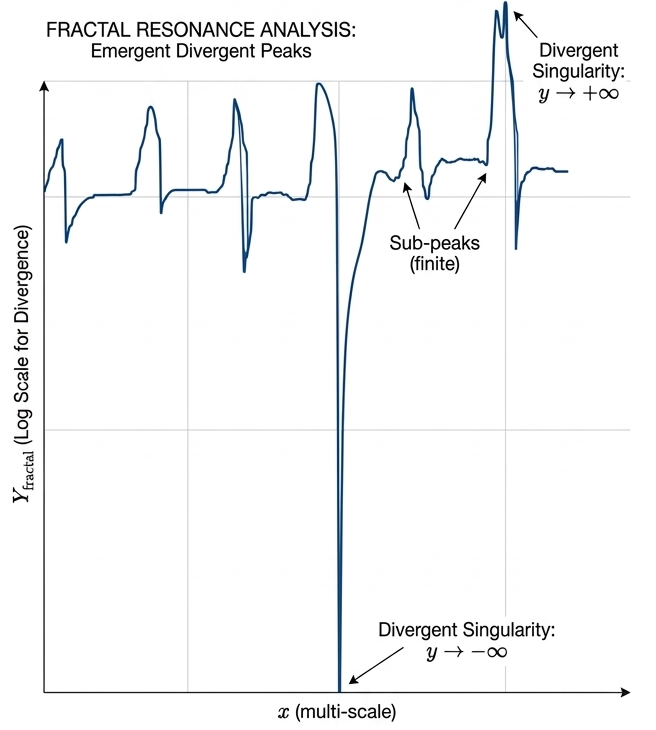
Let us consider this process on a chart at a larger scale (on a larger fractal):
In this figure, it is evident that the frequency of the !flow's !time slots is identical, while the amplitude (the probability of a catastrophe, as in the figure) varies. This occurs because we are dealing with a multiplicity of mutually interfering event !flows, and when oscillations of different fractal dimensions coincide, a sharp increase in the probability amplitude of the event occurs (divergence to infinity, singularity). Predicting the oscillation amplitude is difficult, but predicting the !time slot when a catastrophe (or, conversely, a positive event) may occur can be done with fairly high accuracy.
Another paradigm that allows viewing event !flows through the lens of language model operations: Imagine our !reality as a large analog LLM (aLLM). One might assume that any event could happen within it, but that is not the case. For example, if you want to go to the store, you must execute a strict sequence of actions (analog LLM transactions): Dress → grab wallet → get into car → drive to store → park → grab a cart, etc.
The generation chains of an analog LLM are these same event !flows. If we want to go to the store, there is no need to compute the entire possible cloud of tokens and transactions. Each subsequent token can only be followed by a limited set of options, so it is sufficient to compute the most probable path of the event !flow drain (generation chains of the analog LLM). This principle is utilized by an aLLM-bot modeling which event token will prove to be the most probable within the processed generation chain. ConclusionThe above describes the basic mechanism of interaction between event !flows and external synchronization. Since !marker patterns are unique to each object — whether a person's neurophysiological profile, corporate risks, or social process dynamics — the practical application of the model requires individual adjustment to a specific system. If you need to determine !time slot schedules, recognize !markers, and model a target generation chain for your task, the framework details are calculated upon individual request. |