Contact us.
e-mail: info@trallm.io
|
|
|
Theory of !resonances. Analog LLM. Contact us. e-mail: info@trallm.io |
|
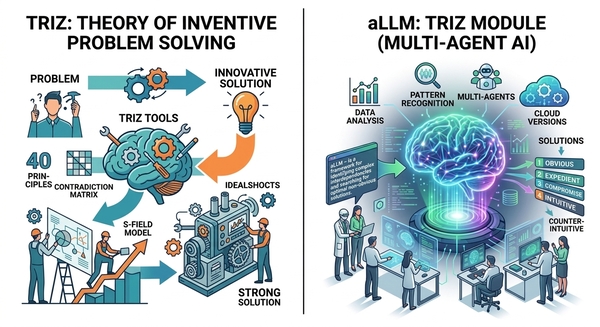
TRIZTRIZ (Theory of Inventive Problem Solving) was formulated by G. S. Altshuller in the last century as a system of core tools for cognitive analysis. Today, TRIZ is actively applied not only in engineering but also in business. The methodology allows finding the shortest path to a goal under conditions of high uncertainty and data deficit. At the same time, the Theory of !resonances (t!r) offers a number of additional tools that expand the capabilities of TRIZ, while multi-agent large language models (aLLM) are capable of serving as its digital module. Imagine that you are solving a complex engineering or business problem. You have tried all options, reached a dead end, and have been going in circles for months, but you need a "strong solution" (a term from TRIZ). Classical TRIZ offers about two dozen tools. In addition to the well-known brainstorming, there are methods for transforming a dead-end problem to engage brain resources:
What happens while using these tools? Our dead-end problem is recorded in the brain in the form of an already formed neural network. This network does not interact in any way with everyday neural networks (for example, "going to the supermarket on the weekend"). Working on a problem for a long time, we generate waves of activity, but they all circulate inside the same closed circuit.
TRIZ tools break this pattern:
Theory of !resonances Approach and the Use of aLLMThe Theory of !resonances offers using aLLM as a TRIZ module. Do you have a dead-end problem? You describe it to the multi-agent AI. The aLLM builds a "cloud of versions," conducts a web search, and checks patterns of similar situations. Then the system selects the most viable options from the perspective of !reality. At the output, you receive an answer: ranging from "that's obvious!" to counterintuitive ideas that you think about for another three weeks before taking a step forward. The aLLM similarly activates a person's unused neural networks, but does so through the automatic analysis of a giant array of options, which is significantly more effective than re-labeling the problem through a fairy tale or "little people." |