
Theory of !resonances. Analog LLM.
Contact us.
e-mail:
  info@trallm.io

HOME             THEORY OF !RESONANCES               aLLM                                   


 Main
Theory of !resonances
TRIZ
aLLM

t!r Definitions
Resonances and synchronicity
External synchronization
Slots and i!l harmonics
!fluctuation
Le Chatelier
!Nonlinear bifurcation
!event flows
!flow !marker
!Cycle 3

Site News
aLLM beta testing.


Theory of !resonances is an active management framework that transforms
reactive response to the event flow into its predictive analysis and proactive regulation.

Synchronicity and Nonlinear !Resonance of the Event !Flow

Events occurring in surrounding !reality often appear synchronized to us. Everyone has noticed strange coincidences at least once. Observing an object followed by its breakdown ("looked at it or praised it — and it broke") is one of the most common patterns that human thinking tends to link into a cause-and-effect relationship.

How it looks in everyday life:
  • Event A: You notice that an object is working properly, or you praise it: "Wow, this car hasn't let me down once in five years!"

  • Event B: A short time later (on the same day or within a week), a breakdown occurs or a tire goes flat.

Other common phenomena:

  • "Washed the car (A) — it started raining (B)"

  • "Thought of a person (A) — they texted or called (B)"

  • "Just stepped away from the bus stop (A) — the bus arrived immediately (B)"

Carl Gustav Jung's Concept

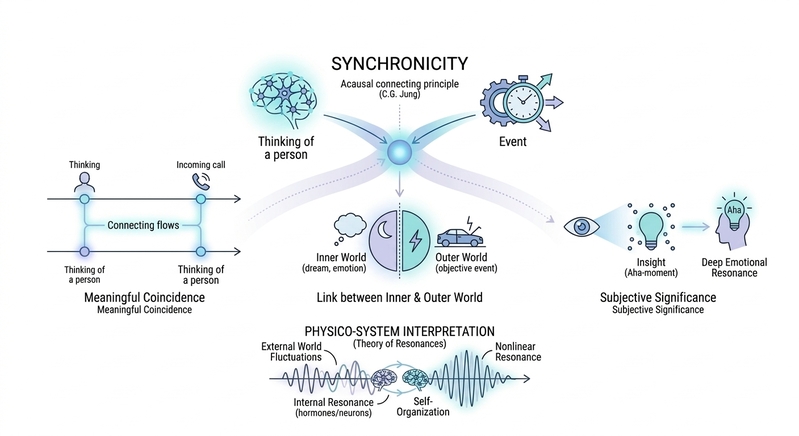
Swiss psychiatrist Carl Gustav Jung proposed the term "synchronicity," defining it as an "acausal connecting principle" — a meaningful connection between events that lacks a direct physical cause-and-effect dependency.

The essence of the concept boils down to three key points:

  1. Meaningful Coincidence Instead of Causality. Unlike the classical "cause → effect" chain, in synchronicity, one event does not physically cause the other. They occur in parallel but are united by a shared meaning for the observer.

  2. Interconnection of the Internal and External. The phenomenon arises at the intersection of two systems:

    • Internal (a thought, emotional state, premonition, dream);

    • External (an objective physical event).

  3. Subjective Significance. The main criterion of synchronicity is the observer's emotional response. The event is perceived not as blind chance, but as a significant phenomenon that actualizes processes in the unconscious.

Physical-Systemic Interpretation (t!r)

The Theory of !resonances describes this phenomenon as a nonlinear !resonance of the event !flow.

From a physical point of view, all objects, subjects, and processes are in a state of continuous oscillations and changes. Let us analyze this mechanism using a human being as an example:

The organism functions in a dynamic external (social) environment while simultaneously under the constant influence of a changing hormonal background and neurochemical oscillations.

Let us consider the operation of this mechanism sequentially:

Biological and Neurophysiological Mechanisms of Event !Resonance

As medical and emergency service statistics show, full moon and new moon periods correlate with a spike in calls: domestic conflicts and rash acts with severe consequences become more frequent.

From the natural science perspective, this process represents external synchronization of the hormonal balance of living organisms. The mechanism of the influence of gravitational disturbances is described in detail in research by the Arctic and Antarctic Research Institute* (V. M. Vorobeychikov, O. A. Troshichev, et al.).

Gravitational Impulse and Microbiota

An immense number of microorganisms inhabit the human body. In particular, Escherichia coli bacteria possess circadian and circalunar rhythms tied to the process of cell division.
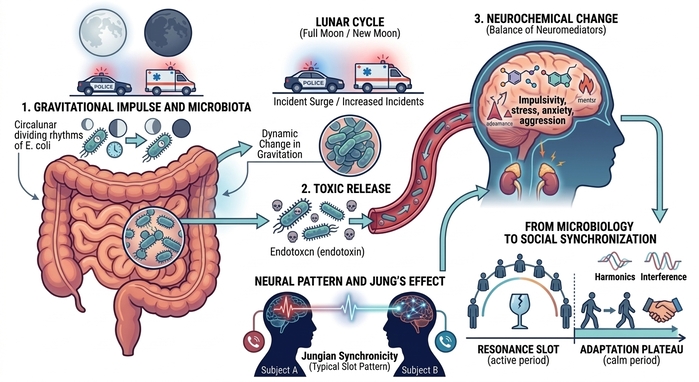
  • Gravitational Impact (!libration peak). At the moment of the full moon and new moon, the Moon passes through specific phases during which the dynamic change in Earth's gravitational field creates micro-oscillations (similar to the effect of brief weightlessness or G-forces on an amusement ride).

  • Toxic Release. The E. coli population system, sensitive to changes in the gravitational field, synchronously enters an active division phase. The avalanche-like growth of the population is accompanied by a sharp release of metabolic products (endotoxins) into the host's bloodstream.

  • Neurochemical Shift. Entering the blood, toxins alter the balance of neurotransmitters and hormones. This provokes impulsivity, elevated anxiety, and unfounded aggression, the causes of which the person themselves often fails to realize.

From Microbiology to Social Synchronization

A simultaneous change in the neurochemical background across multiple individuals escalates into external social synchronization.

  • Resonant Slot. Within the framework of the Theory of !resonances, this cycle of oscillations is called a !time slot. The spike in event activity is followed by a plateau (about two weeks) during which the system adapts to the altered conditions.

  • Harmonics and Interference. The lunar cycle is only one of many frequencies. There are other external synchronizers (harmonics) that create interference and affect !fluctuations in the social environment.

Neural Pattern and the Jung Effect During a !Libration Peak

The human brain registers (memorizes patterns of) neurochemical states and links them with external events:

  • Subject A experiences a shift in neurotransmitter balance, activating neural networks formed during similar periods in the past. At a subconscious level, associations arise (for example: "in this state, I usually communicated with Person B").

  • Subject B, under the influence of the same external factor, simultaneously activates adjacent neural networks ("I need to contact Person A").

  • Physical contact occurs — a phone call or a text message.

What in the classical psychoanalytic tradition is called Jungian synchronicity, in the systemic analysis of t!r represents a typical pattern of the current !resonant slot, or briefly a !marker (the signature of the event !flow).

Conclusion

Described above is the basic framework of how resonant slots work. Because interference and harmonic parameters manifest differently depending on the scale of the system — whether the biochemistry of an individual organism, insurance risk dynamics, or social processes — the applied use of the model requires adaptation to the specific industry context.

----------

* INFLUENCE OF GRAVITATIONAL DISTURBANCES ON THE BEHAVIOR OF HUMANS AND HIGHER ANIMALS. V. M. VOROBEYCHIKOV, O. A. TROSHICHEV, E. S. GORSHKOV, V. V. STEPANOV. State Scientific Center of the Russian Federation Arctic and Antarctic Research Institute.

!Libration is a systemic operator of the Theory of !resonances denoting not a physical visual wobbling of a celestial body, but an extremum point / phase change in a dynamic gravitational system (including planetary stations, synodic cycles, and field interference).


t!r Tools

  Tools for !fluctuations
   Shift of !nonlinear bifurcation
  Fractality, cascades
   IFR according to TRIZ
  Working with what is
  !Entanglement
  Crisis as an evolutionary mechanism
  !Incoming
  !Outgoing
 

  Endocrine system
  Working with the endocrine system
Insight
  Dopamine +/-
  Acetylcholine +/-
  Adrenaline / noradrenaline
  Nothing to do
Abandon project
  Minimalism