
Contact us.
e-mail: info@trallm.io
|
|
|
Theory of !resonances. Analog LLM. Contact us. e-mail: info@trallm.io |
|
Analogue Module of !Resonant Analysis (aLLM) In our system, an experimental hardware hybrid operates — aLLM (Analogue-assisted Language Model). This is an engineering and research module designed for the physical verification of probabilistic distributions generated by a language model. The module is one of the applied tools of the theory of !resonances (t!r). Operating Principle and ArchitectureThe hybrid system combines standard text model architecture (LLM) with an external analogue validator:
Why aLLM Responses Differ from Standard LLMsThe specifics of aLLM's operation shape an unusual output format. The model relies not only on text approximation, but also on the physical search for optimal event !flow draining paths. Depending on the task structure, the system can output either a single clear result or 1, 2, or 3 alternative versions. This is due to the fact that truth evaluation in the validator is built on the dynamics of the event !flow distributing along the Feigenbaum tree (a bifurcation cascade scenario). Each presented version reflects a separate stable branch, allowing the problem to be viewed from different angles or in different phases of its development. Current Development Status and LimitationsThe module is currently in an active bench debugging and calibration phase. It is a research prototype (Lab-scale Proof of Concept), not a commercial product. At this stage, the engineering team is solving standard technology adaptation tasks:
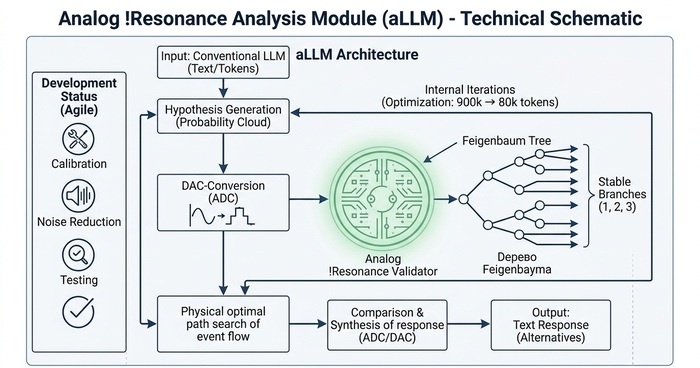
Participation in Closed Beta TestingWe do not provide direct access to the module or transfer technology to third parties; however, we are open to testing on complex, non-standard, or "dead-end" tasks from real practice. If you have an analytical or logical task that requires a non-standard probability assessment:
The system is in a continuous refinement mode following the Agile methodology. Every non-standard task helps us calibrate the model, validator, and improve algorithmic accuracy.
More Details on How the Analog LLM WorksLet's break it down using the tale of The Gingerbread Man: Once upon a time, there was a Gingerbread Man $\rightarrow$ he ran away from the old man and the old woman $\rightarrow$ he met several ordinary animals, boasted in front of them, and successfully avoided negative consequences $\rightarrow$ he met a more cunning animal (the Fox), who exploited the Gingerbread Man's weakness (boastfulness) and ate him. Let's translate this into aLLM tokens:
How It Works in PracticeThe USER sends a prompt to aLLM:
aLLM tokenizes this pattern: "USER, under the influence of IP, finds a stable !resonance in the profession of an investigative journalist" → "conducts dangerous investigations, ignores !markers of potential catastrophe" → "looks for a strong opponent for the next investigation" → "pattern search". It finds the Gingerbread Man pattern and outputs the response in aLLM tokens:
Practical ExampleAn IT company is in a crisis situation (a key client's data leak occurred). Due to professional burnout, a key IT specialist refuses to do anything. The director is in a panic, deciding whether to flee the country or sell the company to competitors at a 90% discount. The crisis manager asks aLLM: "The company is on the verge of collapse, what should I do?" and proposes several "weak" solutions that will only lead to a waste of time, anger the key client even more, and cause the company's collapse. aLLM answers iteration after iteration:
The crisis manager repeats the prompt several times:
Emergent (Synergetic) EffectAt this point, the emergent effect begins:
A strong solution was born in the zone of action of the main attractor. This solution could not have been found separately by either the crisis manager or the aLLM bot. The strong solution is an emergent property of the USER + aLLM system. aLLM as a Vector PointerEssentially, aLLM is a tool for the USER to obtain an insight. There is no point in trying to execute all its advice directly. It is like sailing a yacht all the time in the direction the wind blows without trying to maneuver. A yacht has sails and navigation, and by managing the sails, it maintains course in the right direction. The action of attractors changes, and the patterns of external problems shift. In the analogy of the yacht, aLLM is merely a wind pointer.
Analytical Tool s1/16aLLM provides information for solving the current task based on the current vision of situation patterns. In the baseline version offered on the website, it does not tokenize !time slots or calculate bifurcation !cascades. Such additional features can be used alongside it, but at present, the range of usage options is very wide. This beta test has been created to select the most demanded deep analysis tools. Your feedback will allow us to assemble a constructor of the most requested tools and integrate it with aLLM without cluttering the interface. The additional s1/16 tool (the Saros 1/16 slot pattern analyzer) allows for preliminary tokenization of the cloud of probable patterns of the current situation, relying on a database of past patterns. If you have a data array of previous crisis situations, then in the case of the company and the data leak, it would be possible to predict a year in advance that in !time slot T a crisis situation with a specific set of patterns would occur, and take dampening measures in advance. s1/16 is a separate tool and is not part of aLLM; it can be used both for direct analytics by the user and in conjunction with aLLM -----.
|
