Contact us.
e-mail: info@trallm.io
|
|
|
Theory of !resonances. Analog LLM. Contact us. e-mail: info@trallm.io |
|
Fractals and Cascades of !Nonlinear BifurcationsThe Theory of !resonances views the environment (!reality) not through the customary prism of linear time, but through the dynamics of cycles.
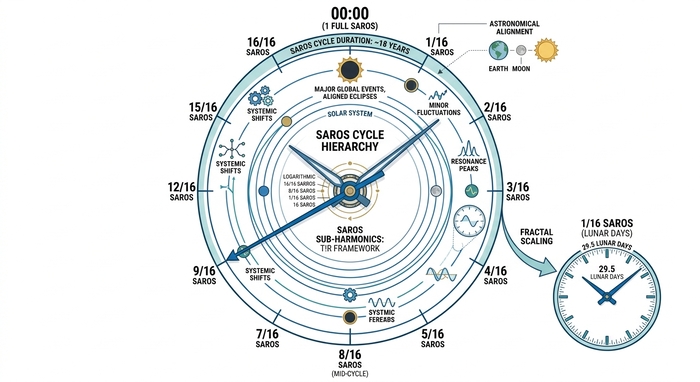
Hierarchy of Cycles and Harmonics in T!RIn t!r, 1 Saros is taken as the base unit of reference for a !time slot — a draconian astronomical cycle lasting ~18 years and 11 days (6585.32 days), after which the sequence of Lunar and Solar eclipses repeats. Analysis of event !flows shows that it is precisely along the Saros that large fractal patterns with a scale of 50–100 years (planetary-level events) can be traced. Structuring processes in t!r relies on a system of harmonic oscillations:
In the Theory of !resonances itself, linear time does not exist — it is applied exclusively to convert cycles into a familiar calendar format. Event !flows are synchronized by waves of varying lengths, but the physics of the process is identical. This creates a strict fractal correspondence between a 2-week cycle (New Moon — Full Moon) and an 18-year Saros. Fractality of Cycles vs. Event !CascadesIt is important to distinguish between the large-scale fractality of cycles and local !cascades within the !flow itself:
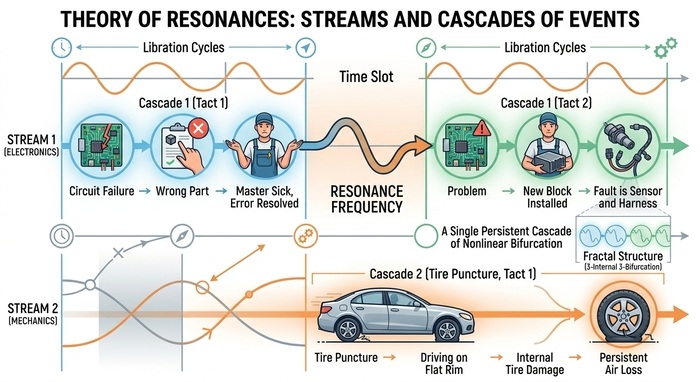
Example of an End-to-End !CascadeConsider a destructive !flow associated with a car breakdown: Cascade 1 (Electronics, Tact 1):Circuit failure occurs → You order a part, but the wrong one arrives → On the follow-up visit, the mechanic falls ill, and the error temporarily disappears on its own. Cascade 2 (Mechanics, Tact 1): Punctured tire → Driving on a flat rim → Internal rubber damage, causing the tire to regularly deflate. Cascade 1 (Electronics, Tact 2): After some time, the electrical issue returns. The mechanic is present, the new unit is in. Despite the fact that the electronics episodes are separated in time and interspersed with other events (a punctured tire), they belong to the same event !flow and reside on the same !resonant frequency. The repeated electrical case merges with the first into a single end-to-end !cascade of !nonlinear bifurcation. |