|
|
|
Theory of !resonances is an active management framework that transforms |
reactive response to the event flow into its predictive analysis and proactive regulation.
|
Nonlinear !Bifurcation
We have considered the entire cycle: !fluctuation → Le Chatelier → !nonlinear bifurcation.
The point of !nonlinear bifurcation is
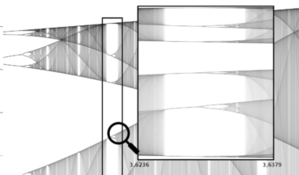
not single — there are always three of them. The dark lines on
the Feigenbaum diagram clearly show how the !flow of events develops
after passing the point of !nonlinear bifurcation.
Various tools of the Theory of
!resonances allow passing the point of !nonlinear bifurcation in
different ways — depending on the result that needs to be
obtained. Previously, we considered passing a cascade of !nonlinear
bifurcations through the paradigm of Reality as a Big Analog LLM.
Practical Example: Managing Environmental Pressure
In our example, a person was subjected
to the simultaneous impact of internal endocrine tension and external
circumstances (a surge of activity provoking aggressive behavior).
To work with the system, passing a cascade of !fluctuations via the shift of !nonlinear bifurcation tool was chosen:
-
System Balancing.
The buildup of Le Chatelier pressure exerted significant psychological
pressure on the person. The endocrine background was aligned using
specialized tools for working with the endocrine system.
-
Passing the Time Slot.
Le Chatelier pressure continues to build up and is subjectively felt as
critical in the moment. The person continues to hold the shift of
!nonlinear bifurcation and approaches the boundary of the !time slot.
-
Fixing the Point.
The limitation of the !time slot does not allow the tension to grow any
further — this is precisely where the last opportunity in this
slot for the realization of the !nonlinear bifurcation point is located.
The Phenomenon of "Non-Choice" and Phase Shift
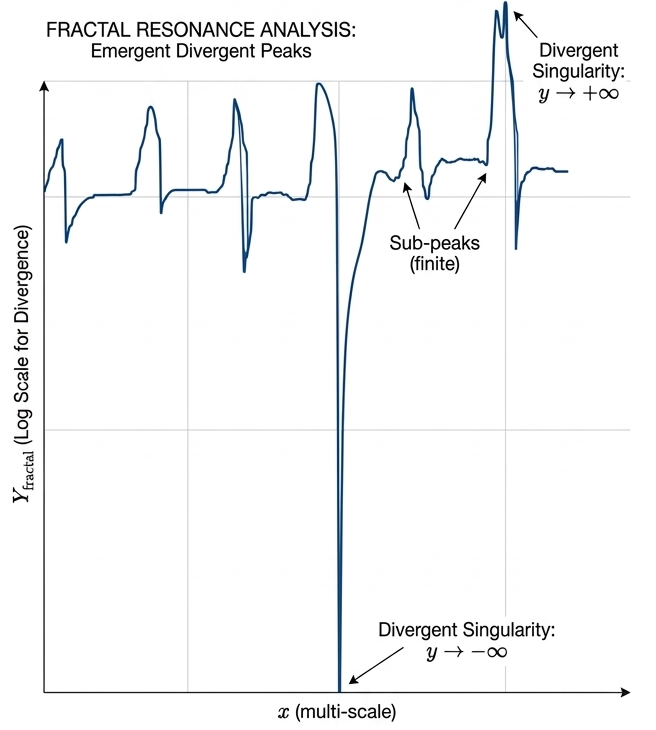
The person makes a non-choice (shift of
!nonlinear bifurcation), which is also a special case of choice —
a refusal to execute a transaction of reality as an Analog LLM.
At this moment, a bounce-back of external environmental pressure occurs from negative to positive:
-
Cause of the Spike:
A strong negative spike on the graph was caused by the summation of
multiple !resonances from different event !flows that coincided in a
negative phase at a certain moment.
-
Phase Shift:
In the next !time slot, all these !flows automatically sum up into a
positive phase. On the graph, this is reflected as a surge of positive
events.
-
Stabilization: Further on, the !flows desynchronize, and the !fluctuation returns to its normal, balanced state.
What Happens to the Event !Flow at the Point of !Nonlinear Bifurcation
At the point of !nonlinear bifurcation, the further dynamics of the system are determined through two key paradigms:
-
Feigenbaum Diagram:
A choice of a specific direction for the event !flow for the next !time
slot takes place — up to the next point of !nonlinear bifurcation.
-
Reality as a Big Analog LLM:
A transaction failure occurs. The model (aLLM) logs the experience: the
draining of event !flow "A" through token "B" is impossible. As a
result — immediately or after several ticks — the aLLM
finds a new path to generate this !flow bypassing token "B" (the
person).
Strategies for Passing the Point of !Nonlinear Bifurcation
-
Shift of !nonlinear bifurcation — a basic tool that proves effective when it is necessary to completely eliminate a negative factor from the event !flow.
-
Ideal Final Result (IFR per TRIZ) — a stronger solution. Instead of a simple shift of !nonlinear bifurcation, a scenario for passing it is found where the harmful factor eliminates itself while simultaneously bringing collateral benefit.
|
|