|
Theory of !resonances is an active management framework that transforms |
reactive response to the event flow into its predictive analysis and proactive regulation.
|
Time Slots and Inter-!librational Harmonic Oscillations
Previously, we examined the physics of the process that causes external synchronization in the social environment. This chain looks as follows:
!Libration (gravitational surge) →
Biological level → Neurophysiological level → Social
synchronizing impulse (using the specific example of external
!resonance "Full Moon — New Moon").
Analysis of event !flows and their
interference shows that 1 Saros is most optimal to take as the base
reference unit for a time slot.
Saros
(or draconic period) is an astronomical cycle lasting approximately 18
years, 11 days, and 8 hours (6,585.32 days), after which lunar and
solar eclipses repeat in a strictly analogous order.
Through the Saros cycle, major event
flows manifesting in a fractal dimension of 50–100 years can be
clearly traced. You can easily verify this by conducting an independent
study of any Saros series to identify common patterns — which are
typically events of planetary scale.
Hierarchy of Cycles and Harmonics in t!r
The Theory of !resonances structures large-scale processes through a system of harmonic oscillations:
-
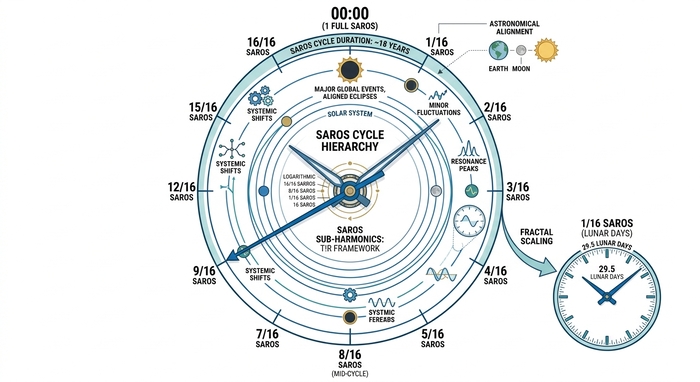
Small cycle (1/16 of Saros) — i!l:
The Saros is divided into 16 harmonic oscillations, which in t!r are
designated as i!l (inter-!librational harmonic oscillations). This
yields a period equal to 14 lunar months, containing the intersection
points of Saros eclipses with the New Moon. In these !time slots, due
to the overlap of two frequencies, an increased event density (or a
higher amplitude on the graph) is observed.
-
Medium cycle (Saros * 16): Comprises a period of roughly ~288 years, through which large-scale !flow patterns can also be traced.
-
Limit cycle (Saros * 16 * 16):
Equals ~4,608 years. For t!r, this is the maximum permissible fractal
dimension, as it is technically impossible to work with cycles of a
larger scale.
Fractality below 1/16 of a Saros is
theoretically also divided into 16 harmonics. However, historically, a
convenient division into lunar days within a lunar month was
established; therefore, for intervals smaller than 1/16 of a Saros,
standard lunar days are applied in t!r.

|
THE SAROS CYCLE (~18.03
yrs)
| +----+----+----+----+----+----+----+----+----+----+----+----+----+
| |i!l |i!l |i!l |i!l |i!l |i!l |i!l |i!l |i!l |i!l |i!l |i!l |i!l |....|
| +----+----+----+----+----+----+----+----+----+----+----+----+----+
| 1/16 Saros (~14 lunar months) = Inter-!librational oscillation
Architecture of Cycles: The Solar System Mechanism
The overall synchronicity of the Solar
System is designed like a clockwork mechanism: the large hands rotate
slowly, while the small ones rotate quickly, but once every 18 years,
they inevitably align.
In addition to the Earth — Moon — Sun system, other cosmic bodies also exert an influence on processes:
-
Influence of Jupiter:
Jupiter creates the most tangible gravitational changes as the most
massive planet. Periods of its approach and opposition form a clearly
distinguishable !flow signature.
-
Contribution of minor planets:
Due to their high speed of divergence from points of opposition and
approach, they are also capable of inducing significant gravitational
perturbations.
Harmonics and Gears of Cycles
The harmonic oscillations of all these
cycles are not chaotic — they are strictly attuned. They can be
metaphorically represented as teeth on the gears of a unified clockwork
mechanism. For instance, the syzygy (alignment in a straight line) of
"Jupiter — Earth — Moon" always falls into one harmonic or
another alongside other astronomical phenomena.
Practical solution of t!r
To simplify the mathematical
framework, a universal interpretation of i!l (inter-!librational
harmonic) has been introduced into the theory.
It allows analyzing harmonic
oscillations by taking a wide range of base points, while
simultaneously calculating parameters of different cycles within the
exact same !time slots.
This significantly simplifies the precise calculation and forecasting of !libration peaks.
|