
|
|
|
Theory of !resonances is an active management framework that transforms |
reactive response to the event flow into its predictive analysis and proactive regulation.
|
!Entanglement: Working with Outgoing Fluctuations and Overcoming Environmental Resistance
The tools of the Theory of !resonances (t!r) are fundamentally divided into two categories:
At
the core of this division lies a large-scale disparity: an individual
system (a person or an organization) and a global system (the
surrounding environment, market reality) are incomparable in terms of
their volume and energy.
A !fluctuation performed by a human toward the external environment (!outgoing), and a !fluctuation directed from the environment toward the human (!incoming), differ radically in terms of !resonance energy. Although the Theory of !resonances offers a paradigm for understanding the essence of event !flows for harmonious interaction with the surroundings, the factor of scale disparity remains decisive when selecting tactics.
The Essence of the !Entanglement Tool
The !entanglement tool belongs to the class of !outgoing tools.
When
a system sets a goal to enter and establish itself in a new zone of the
external environment, it needs to overcome the resistance and
competition of other systems whose !resonant
flows are already present in that territory. According to the logic of
the Ideal Final Result (IFR) from TRIZ, the task is to ensure that
these "alien" !flows do not interfere, but whenever possible, assist in integrating into the new territory.
Main task of !entanglement:
On a !resonant level, find a solution: how to make the existing !resonances of your system get !entangled with the !resonances of the new location with minimal resistance?
Case Study: Entering a New Market (Country A → Country B)
Let us consider the mechanics of !entanglement
using the example of a small dietary supplement company, successful in
Country A (a developed market) and planning expansion into Country B (a
developing market).
Stage 1: Passive Observation (Lack of Interaction)
The
company's director, during a vacation in Country B, notices the absence
of dietary supplements in pharmacies and decides to start sales. At the
end of his vacation, he leaves. At this moment, !entanglement does not occur, as there is no !fluctuational interaction with the !flows of Country B's business environment.
Stage 2: Template Transfer and Deadlock
Having returned to Country A, the director acts according to a familiar methodology that has worked repeatedly in the past:
-
Creation of a local website;
-
Registration of a legal entity;
-
Hiring staff and launching an advertising campaign.
The result is zero:
-
The website receives irrelevant traffic or budget "click fraud" without leads;
-
Only spam offers and resumes from candidates with no pharmaceutical experience are received;
-
Applicants lack the required qualifications yet demand higher pay than in Country A.
A deadlock arises. The phase requiring the application of the !entanglement tool begins.
Dynamics of !Entanglement via Agile and Feigenbaum Trees
The director begins applying targeted !outgoing !fluctuating
pressure on the market of Country B. He utilizes all touchpoints,
analyzes reactions, posits hypotheses, and tests them using Agile
methodology: he alters content, restructures ad strategies, abandons a
physical office, modifies the product positioning model, etc.
[!Outgoing pressure of the system] ──> [Environmental resistance (Le Chatelier)]
│
▼
[Agile correction]
│
▼
[Point of !nonlinear bifurcation]
│
▼
[!Entanglement with !flows B]
-
Growth of reactive pressure: As the director continues to press the market with his system's resources, regular !fluctuations arise. In response, resistance builds according to the Le Chatelier principle.
-
Manifestation of strategy errors:
As pressure increases, hidden flaws in the original business plan are
exposed. The director rapidly corrects them using short Agile
iterations.
-
Passing points of !nonlinear bifurcation: At a point of !nonlinear bifurcation, only one of two !fluctuating !flows must survive. The director's experience and timely adaptation allow him to win most of these micro-conflicts.
-
Fixation of !entanglement: At each branching step (following Feigenbaum diagrams), micro-adaptations occur. In every !fluctuation, the system displaces local competitors or integrates with them, taking their place at the !resonant level.
Ultimately, the !resonant energy of the environment's counteraction, which initially blocked entry, transforms into a useful outcome:
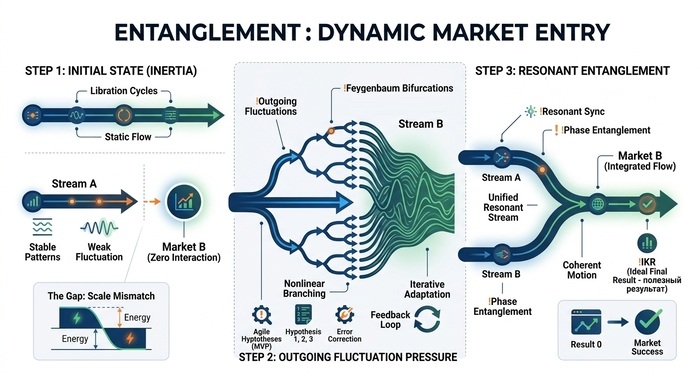
-
On a physical level: A viable business model is created, adapted to the !reality of Country B.
-
On a !resonant level: Complete !entanglement of the company's !flow with the !flows of the new market takes place.
!Entanglement
is an adaptive resonant process of nonlinear phase and
interaction-pattern alignment between a smaller-scale local system
(subject/organization) and a macro-system with high entropy and
nonlinear dynamics (external environment/market), executed through a
series of targeted !outgoing !fluctuations.
From the perspective of synergetics and dynamical systems theory, !entanglement is described by the following propositions:
-
Phase Synchronization via Resistance (Le Chatelier Principle):
When applying local !fluctuating
pressure to a macro-system, counteracting reactive responses arise.
Passing through these resistance points allows the local system to
continuously adjust its internal parameters (including cognitive models
and business architecture) until its intrinsic oscillation frequency
enters coherent !resonance with the intrinsic oscillations of the external environment.
-
Movement along the Feigenbaum Scenario:
The process of !entanglement is realized as a sequential passage through a cascade of !nonlinear bifurcation
points. At each branching point, the system cuts off non-viable
illusory patterns and integrates into the most stable trajectories
(attractors) of the external macro-system.
-
Energy Transformativity (IFR in TRIZ):
Instead of expending extensive resources to overcome environmental inertia, !entanglement
converts the excessive resistance energy of the macro-system into a
working driver of integration. As a result, the initial entry barrier
is transformed into a connecting resonant !flow, unifying the !resonant !flows of the local system and the environment into a single whole.
|
|