Contact us.
e-mail: info@trallm.io
|
|
|
Theory of !resonances. Analog LLM. Contact us. e-mail: info@trallm.io |
|
Crisis from the Perspective of the Theory of !resonances Crisis in the Theory of !resonances is viewed not as a catastrophe, but as a fundamental evolutionary mechanism. Its key objective is to maintain self-organization processes in all types of systems and to ensure their continuous adaptation to dynamically changing environmental conditions. Mechanics of Adaptation: From Survival to Trimming the ExcessWhen a global environmental !fluctuation occurs—such as war, a rapid shift in technological paradigms, economic downturn, or a social shift—absolutely all systems are forced to engage adaptive mechanisms. Under external threat, a system physically cannot function in its previous format: it strips away secondary processes for the sake of a single priority goal—its own survival. [External !fluctuation] → [Internal imbalance (Le Chatelier)] → [Optimization of functions] → [Evolution of the system]At both micro- and macro-levels, the following phases unfold:
As a result of this rigorous selection, a natural evolution of the system's architecture takes place. Cyclicity of Self-Organization ProcessesAfter successfully passing through a crisis and stabilizing external !flows, the system gradually exits emergency survival mode and transitions into the principle of least action (minimization of energy expenditure).
In this manner, systemic self-organization is accomplished: an organization or individual acquires a new stable parameter (pattern) that allows it to successfully pass through another !nonlinear bifurcation point and reach a new level of coherence with the environment.
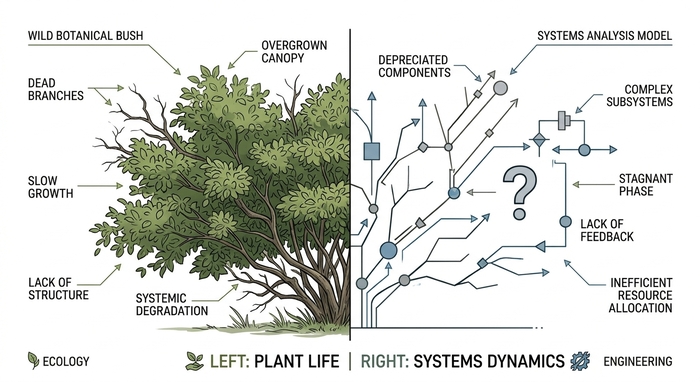
Visual Illustration: The Pruning EffectLet us examine this process through the example of a wild shrub. If a bush grows on its own under conditions of total calm and absence of external stressors, it gradually begins to degrade: dry and diseased branches accumulate, the crown thickens, inner shoots lack light, and overall growth slows down. The system becomes trapped in redundancy. A shrub subjected to hard pruning every season experiences severe physiological stress. However, it is precisely this stress that breaks down the old structure, unlocks dormant buds, and forces the plant to redirect all its sap toward forming new, strong shoots. As a result, a bush that regularly undergoes a managed "crisis" turns out to be significantly more viable, denser, and younger than one that grew without stress. |