
1. Introduction to the Theory of !resonances and framework concept
Theory of !resonances
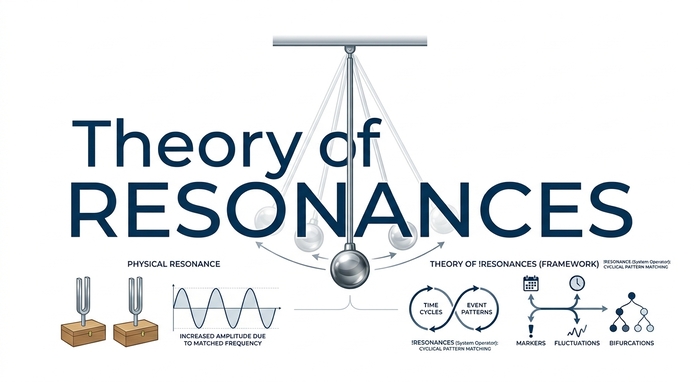
Theory of !resonances is a paradigm that allows looking at surrounding !reality through the lens of cyclicity and event pattern repeatability. The exclamation mark "!" preceding terms in the Theory of !resonances (t!r) clearly distinguishes the systemic operator !resonance from the common physical term resonance, which denotes an increase in oscillation amplitude when frequencies match.
In essence, the Theory of !resonances is a practical toolkit (framework). It allows you to:
Navigate in cyclic time and identify stable event patterns (!markers).
Work with !fluctuations — physical interactions with the external environment.
Analyze !nonlinear bifurcations — tipping points and multi-variant system development.
Apply auxiliary techniques for self-regulation and managing endocrine load in crisis situations.
About the project and participating in t!r development
This resource presents key theses and basic tools of the Theory of !resonances (t!r) designed for initial acquaintance with the concept.
Since t!r is a dynamically evolving framework, we are open to dialogue and gratefully accept community contributions:
Concept development: You can participate in refining the methodology by sending your suggestions, constructive criticism, or observed patterns.
Practical application: Our team provides individual consultations on integrating t!r methods into specific life, business, and crisis situations.
Research exchange: Send your cases and registered !markers — the most interesting observations will enter the common knowledge base.
How to contact us? Write to us at info@trallm.io to ask a question about practical framework application or propose a joint research topic.
2. TRIZ and Multi-Agent AI (aLLM)
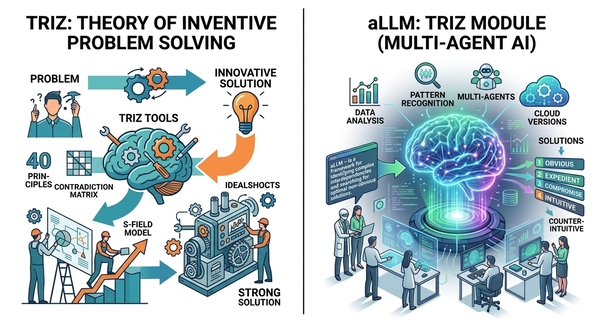
TRIZ (Theory of Inventive Problem Solving) was formulated by G. S. Altshuller in the last century as a system of basic tools for cognitive analysis. Today, TRIZ is actively applied not only in engineering, but also in business. The methodology allows finding the shortest path to a goal under conditions of high uncertainty and data deficit.
At the same time, the Theory of !resonances offers additional tools that expand the capabilities of TRIZ, while multi-agent language models (aLLM) can act as its digital module.
Imagine you are solving a complex engineering or business task. You have tried all options, reached a dead end, and have been going in circles for months, while needing a "strong solution" (a term from TRIZ). Classic TRIZ offers about two dozen tools. Beyond well-known brainstorming, there are methods for transforming dead-end tasks to engage brain resources:
"Little People Method" — proposing to represent the problem as a set of small actors (little people) and try to solve it at this micro level.
"Fairy Tale Method" — re-designating the problem and its participants into fairy tale characters while trying to write a script for how they would exit the deadlock.
What happens while using these tools? Our dead-end problem is written in the brain as an already formed neural network. This network does not interact with everyday neural networks (e.g., "going to the supermarket on weekends"). Working on a problem for a long time, we generate waves of activity, but they all circulate inside the same closed loop.
TRIZ tools break this pattern:
In brainstorming, several people express the strangest assumptions, activating unused neural networks in other participants. As a result, bold insights emerge — some are discarded, but some remain, and an exit from the deadlock is found.
In redefining a problem into a fairy tale, the same happens inside one person's mind. By translating a problem from real to fairy-tale, they similarly activate new neural networks, receive multiple insights, and find a solution.
Theory of !resonances Approach and aLLM Application
The Theory of !resonances proposes using aLLM as a TRIZ module. Got a dead-end problem? You describe it to multi-agent AI. aLLM builds a "cloud of versions", conducts web searches, and verifies patterns of similar situations. The system then selects the most viable options from a reality perspective.
At the output, you receive an answer ranging from "it's obvious!" to counter-intuitive ideas that you contemplate for three weeks before making a step forward. aLLM similarly activates unused human neural networks, but does so by automatically analyzing a giant array of options, which is significantly more effective than redefining a task via a fairy tale or "little people".
3. Analogue !resonance Analysis Module (aLLM) & Closed Beta Testing
Analogue !resonance Analysis Module (aLLM)
Operating within our system is an experimental hardware hybrid — aLLM (Analogue-assisted Language Model). This is an engineering research module designed for physical verification of probability distributions generated by a language model. The module is one of the applied tools of the Theory of !resonances.
Operating Principle and Architecture
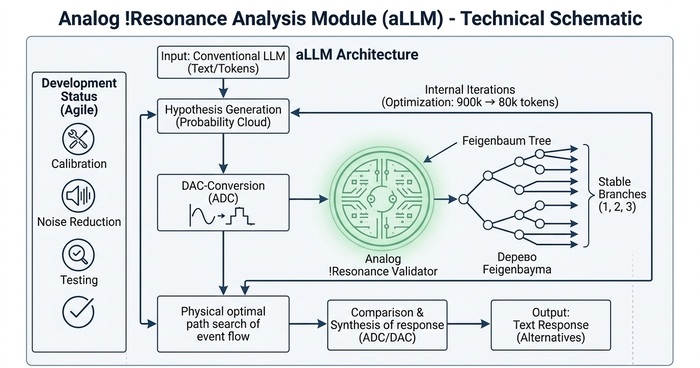
The hybrid system combines standard text model architecture (LLM) and an external analogue validator:
Hypothesis generation: Multi-agent software complex forms a probabilistic cloud of response versions and options.
Validation: Analogue module determines which version has the highest potential for event !flow runoff.
Search and iterations: Flexible configuration of internal iterations, including refining web search across selected directions, filters out noise.
Synthesis: Final verification of result stability and final text response generation.
Why aLLM Answers Differ from Standard LLMs
The specifics of aLLM operation form an unusual output format. The model relies not only on text approximation, but also on physical search for optimal event !flow runoff paths.
Depending on problem structure, the system can issue a single clear result or 1, 2, or 3 alternative versions. This is because truth evaluation in the validator is built on event !flow dynamics distributed across the Feigenbaum tree (bifurcation cascade scenario). Each presented version reflects a distinct stable branch, allowing viewing the problem from different angles or in different development phases.
Current Development Status and Limitations
The module is in the phase of active bench debugging and calibration. It is a research prototype (Lab-scale Proof of Concept), not a commercial product.
At this stage, the engineering team solves standard technology adaptation tasks:
Reducing physical noise in measurement circuits.
Increasing stability of result convergence.
Optimizing internal iterations.
Participation in Closed Beta Testing
We do not provide direct access to the module nor transfer technology to third parties, but are open to testing on complex, non-standard, or "dead-end" tasks from real practice.
If you have an analytical or logical task requiring non-standard probability estimation:
Work format: Asynchronous (request–response).
Communication channels: Email or isolated secure channels (by agreement).
Processing time: From 30 minutes to several hours per request (depends on computing bench load and set number of internal iterations).
The system is under continuous refinement using Agile methodology. Every non-standard task helps us calibrate the model, validator, and improve algorithm precision.
Detailed Principle of Analogue LLM Operation
Let's examine using the Gingerbread Man (Kolobok) fairy tale:
Once upon a time lived Kolobok → he ran away from grandparents → met several ordinary animals, boasted, and successfully avoided negative consequences → met a slyer animal (Fox), who used Kolobok's weakness (boastfulness) and ate him.
Translating into aLLM Tokens
USER → «under EP (exploratory behavior) experienced acetylcholine surge (!ach+)» → «!took unnecessary !resonance (ran away from home)» → «passed !fluctuation cascade with weak animals, violated safety protocol under elevated hormonal background, ignored multiple !markers of potential catastrophe» → «met strong animal who exploited USER's hormonal background in their interest, weakening defense mechanisms» → «in large fractal !fluctuation Fox won, her flow received physical reinforcement (nutrition), while Kolobok's !flow was terminated».
How It Works in Practice
USER sends a request to aLLM:
Task Submission for aLLM Beta Testing
This form is intended for submitting research and non-standard tasks for verification in the analogue resonance analysis module.
We seek "dead-end", analytical, or multi-variant tasks where classical language models fail to yield unambiguous results or slide into template text generation.
Input Data Requirements:
Task formulation: Describe baseline data, situation context, and key question.
No critical personal data: Do not transfer confidential commercial or personal information (data privacy).
Task format: Limit to text descriptions, logic diagrams, or evolving event scenarios.
Application Submission Requirements & Access Validation
To ensure information security and protection against unauthorized use of !analogue LLM resources, task processing during beta testing is conducted in a strictly restricted perimeter.
1. Category Restriction for Applicants
Access to the resonance analysis module is provided exclusively to:
Legal entities and corporate sectors;
Authorized government agencies;
Profile research institutes and laboratories.
Applications from individuals and anonymous users are automatically rejected.
2. Corporate Domain Authorization
Applications must be sent strictly from a corporate or institutional email address registered on the organization's own domain.
Refusal of service: Requests sent from public email services (
@gmail.com,@hotmail.com, etc.) are not processed and are deleted.
Data Processing Rules & Privacy
To ensure security and protection of your information during bench testing, the following standards apply:
Isolated processing: All input data is processed exclusively on our own local server. We do not view or track your internal correspondence with aLLM on the server.
Web search anonymization: If the algorithm initiates internet search to clarify context, the request is formed strictly anonymously — original prompt text is not sent to external search engines.
Privacy: We do not accumulate user request databases nor transfer received information to third parties.
Secure channel: If transmission via an isolated communication channel is required, indicate this in your email — we will offer connection options.
Working Concept: Emergence Principle
The aLLM bot is not a "magic pill" that independently solves dead-end exit tasks.
If a situation is complex and the solution lies in high uncertainty, neither human nor algorithm can find it individually. A breakthrough result does not arise on its own — an emergent property appears exclusively during joint work on a problem. An effective solution is born only inside the synergetic system «Human + aLLM».

4. Resonances and Synchronicity
Synchronicity and !nonlinear !resonance of event flow
Events occurring in surrounding !reality often seem synchronized. Everyone has noticed strange coincidences: looking at an object or praising it ("looked or praised — and it broke") is one of the most common patterns human thinking connects into cause-and-effect.
How it looks in daily life:
Event A: You notice an object works fine or praise it: «Incredible, this car hasn't failed once in five years!»
Event B: Shortly after (same day or within a week), a breakdown or flat tire occurs.
Other common phenomena:
«Washed the car (A) — it rained (B)»
«Thought of a person (A) — they texted or called (B)»
«Stepped away from the bus stop (A) — the bus arrived immediately (B)»
Carl Gustav Jung's Concept
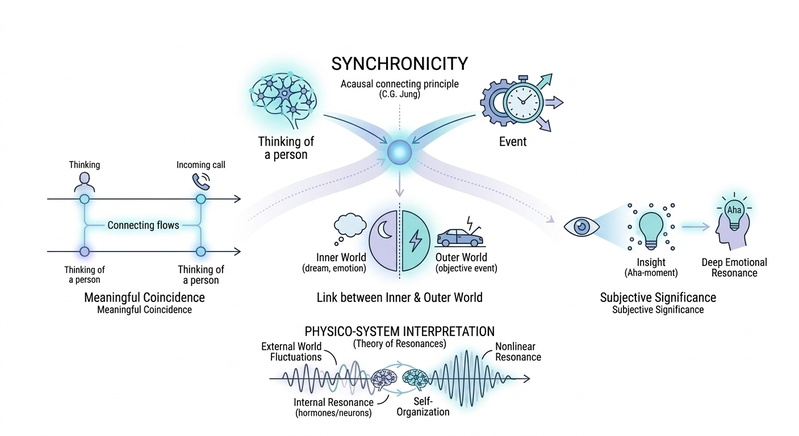
Swiss psychiatrist Carl Gustav Jung coined the term «synchronicity», defining it as an «acausal connecting principle» — a meaningful connection between events without direct physical cause-and-effect dependence.
The essence comes down to three key provisions:
Meaningful coincidence instead of causality. Unlike classical "cause → effect", in synchronicity one event does not physically cause another. They occur in parallel, united by common meaning for the observer.
Interconnection of internal and external. The phenomenon occurs at the junction of two systems: Internal (thought, emotional state, premonition, dream) and External (objective physical event).
Subjective significance. The main criterion is the observer's emotional response. The event is perceived not as blind chance, but as a significant phenomenon actualizing unconscious processes.
Physical-Systemic Interpretation (t!r)
The Theory of !resonances describes this phenomenon as !nonlinear !resonance of event !flow.
From a physical perspective, all objects, subjects, and processes exist in continuous oscillations. Let's analyze this mechanism using humans as an example:
An organism functions in a dynamic external (social) environment, simultaneously under constant influence of changing hormonal backgrounds and neurochemical fluctuations.
Biological & Neurophysiological Mechanisms of Event !resonance
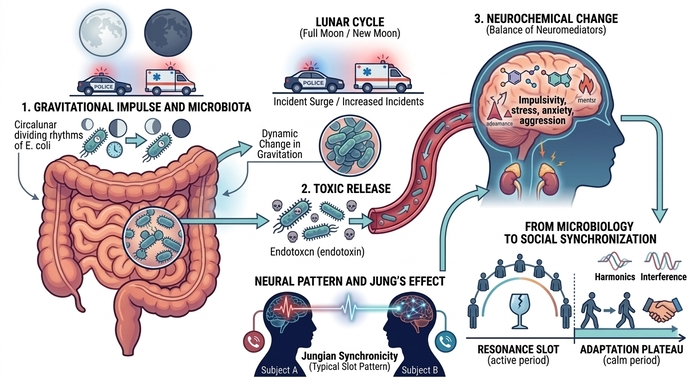
As statistics from medical and emergency services show, full moon and new moon periods correlate with call surges: domestic conflicts and rash acts increase.
From a natural science perspective, this process represents external synchronization of living organism hormonal balance. Gravitational disturbance influence mechanisms are described in detail in Arctic and Antarctic Research Institute studies* (V. M. Vorobeychikov, O. A. Troshichev et al.).
Gravitational Impulse and Microbiota
The human body harbors vast microorganism populations. In particular, Escherichia coli bacteria possess circadian and circalunar rhythms tied to cell division.
Gravitational impact (!libration peak**). At full and new moons, Earth's dynamic gravitational field changes create micro-oscillations.
Toxic release. The sensitive E. coli population system synchronously enters active division phase. Rapid population growth releases metabolic endotoxins into host bloodstream.
Neurochemistry shift. Toxins alter neurotransmitter and hormone balance, provoking impulsivity, elevated anxiety, and unfounded aggression.
From Microbiology to Social Synchronization
Simultaneous neurochemical background shift across multiple individuals escalates into external social synchronization.
Resonant slot. In the Theory of !resonances, this cycle is called a !time slot. Event activity surge is followed by a plateau (~2 weeks) while the system adapts.
Harmonics and interference. The lunar cycle is just one frequency. Other external synchronizers (harmonics) exist, creating interference affecting social fluctuations.
Neural Pattern and Jung Effect During !libration Peak
The human brain registers neurochemical states and connects them with external events:
Subject A experiences a neurotransmitter balance shift, activating neural networks formed in past periods (e.g., «in this state I usually communicated with Person B»).
Subject B under the same external factor simultaneously activates adjacent neural networks («need to contact Person A»).
Physical contact occurs — phone call or message.
What classical psychoanalysis calls Jungian synchronicity, in t!r systemic analysis is a typical pattern of current !resonance !time slot or briefly !marker (signature of event !flow).
Conclusion
The base framework of resonant slot operation is described above. Since interference parameters and harmonics manifest differently depending on scale — biochemistry, insurance risk dynamics, or social processes — practical model application requires adaptation to specific domain contexts.
5. Process Synchronization and Time Slots
External synchronization in social environments operates via: !libration (gravitational surge) → biological level → neurophysiological level → social synchronizing impulse.
This process forms stable !resonance — regularly repeating behavior patterns of people and social groups.
Life Examples:
Regularly recurring conflict with a neighbor or colleague.
Situations where a person repeatedly fails to handle emotions and breaks promises.
Cyclically occurring economic crises.
When an event repeats with specific periodicity, the Theory of !resonances designates it as an event !flow.
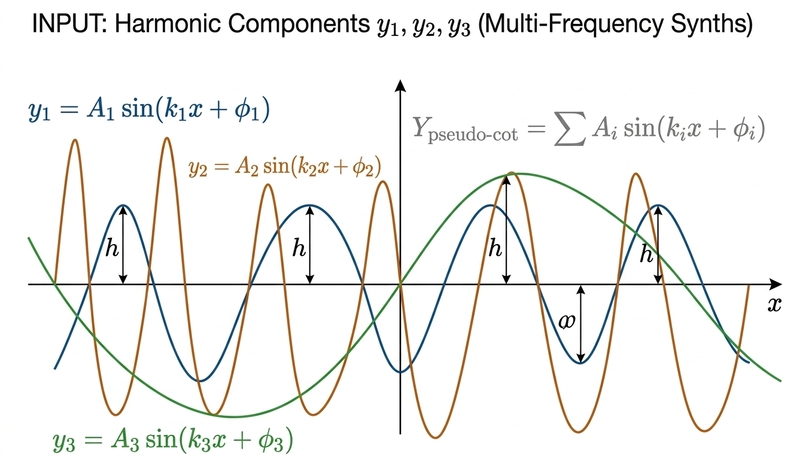
At any moment, over 10 major external synchronizations operate, creating interference interactions and harmonic oscillations:
As soon as an internal parameter (neurobiological balance or group dynamics) matches external synchronization frequency, the system enters !resonance with the governing external oscillation.
As a result, a constant event !flow forms with regularly repeating behavior patterns.
Interference and Event Antinodes
Because many such !flows exist with different frequencies, superposition (frequency addition) occurs at specific moments. This leads to event antinodes (activity surges) and quiet zones.
Everyday speech describes these phases as:
«Everyone went crazy today» — maximum antinode point.
«Where did everyone go, where are clients?» — reduced activity zone.
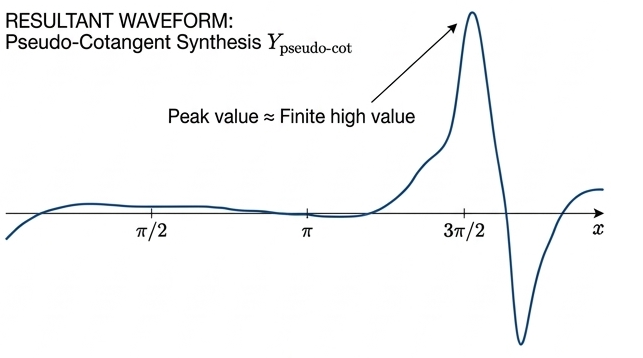
At peak moments, numerous physical interactions occur (!fluctuations in t!r terminology). In quiet zones, extremely low interaction counts are recorded.
Each event !flow has its signature — repeating patterns designated in t!r as a !marker of !flow.
Predicting Flow Activity
t!r tools allow active work with !time slots:
Identification: Knowing 2+ repeated !markers, active !time slots of observed !flow can be determined.
Extrapolation: Next active !time slots are identified.
Prediction: High probability prediction of which slot will repeat events of this !flow.
Let's examine this process on a larger scale (larger fractal):
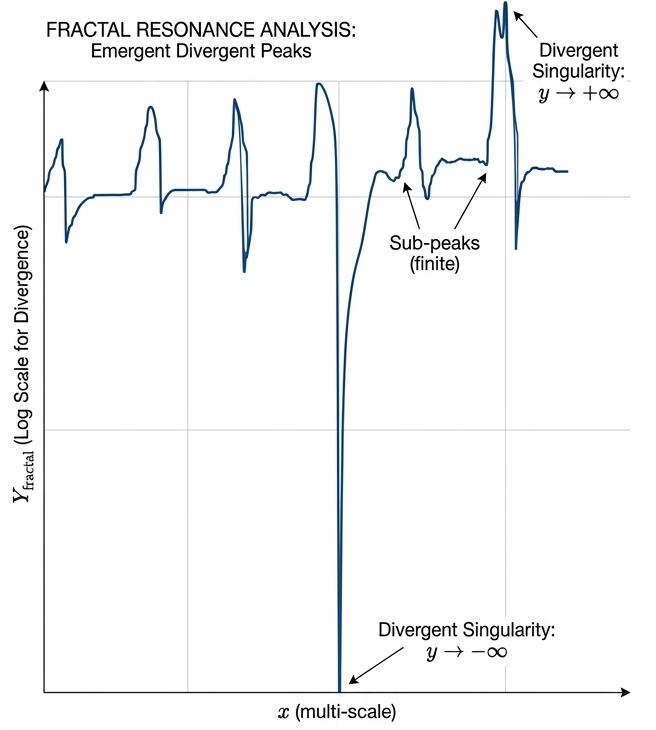
The graph shows !flow !time slots frequency is identical, while amplitude (catastrophe probability) varies due to mutually interfering event !flows. When different fractal dimension oscillations match, event probability amplitude surges sharply.
Predicting oscillation amplitude is hard, but predicting the !time slot when a catastrophe (or positive event) might occur is highly accurate.
Stability & Patterns: Depending on !flow stability, patterns repeat with 10% to 90% probability.
Event & Marker Frequency: Catastrophes may occur once in dozens or hundreds of cycles, but catastrophe !markers repeat according to !time slots.
Another paradigm views event !flows through language model lenses:
Imagine !reality as a large analogue LLM (aLLM). A strict transaction chain is required to achieve goals (e.g., going to a store):
Get dressed → take wallet → get in car → drive to store → park → grab shopping cart etc.
Chain failure: If a token/transaction is missing, generation breaks. Forgetting car keys causes a model rollback at "drive to store".
Searching alternatives: Analogue LLM searches alternative token paths: take a bus, walk, etc.
Analogue LLM generation chains are event !flows.
6. Time Slots, Saros Cycles, and Inter-!librational Harmonics
Time Slots and Inter-!librational Harmonic Oscillations
Previously we examined the physics causing external social synchronization:
!Libration (gravitational surge) → Biological level → Neurophysiological level → Social synchronizing impulse.
Analysis of event !flows shows the optimal base time slot unit is 1 Saros.
Saros (draconic period) is an astronomical cycle of ~18 years 11 days 8 hours (6585.32 days) after which lunar and solar eclipses repeat in identical order.
Major event flows are clearly traceable along Saros cycles in 50–100 year fractal dimensions.
Cycle & Harmonic Hierarchy in t!r
t!r structures large-scale processes via harmonic oscillations:
Small Cycle (1/16 Saros) — i!l: Saros divides into 16 harmonic oscillations designated in t!r as i!l (inter-!librational harmonic oscillations). This yields 14 lunar months (~410 days), where Saros eclipse intersections with New Moon occur. Overlapping frequencies create higher event density.
Medium Cycle (Saros * 16): Equals ~288 years, revealing large-scale !flow patterns.
Limit Cycle (Saros * 16 * 16): Equals ~4608 years. Maximum allowable fractal dimension for t!r analysis.
For intervals below 1/16 Saros, standard lunar days apply.
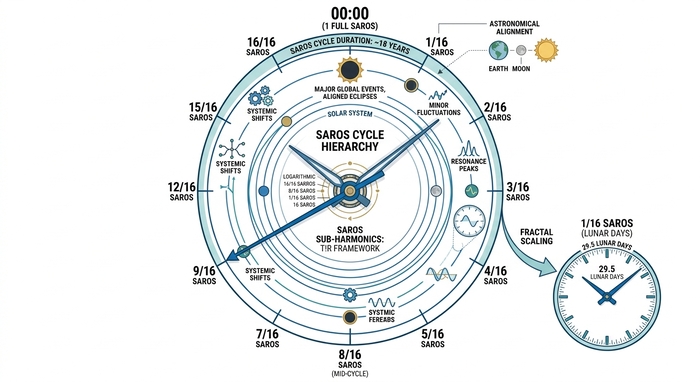
Cycle Architecture: Solar System Mechanism
Overall Solar System synchronicity functions like clockwork: large hands rotate slowly, small hands rapidly, but every 18 years they align.
Beyond the Earth — Moon — Sun system, other celestial bodies influence processes (Jupiter, minor planets).
Harmonics & Cycle Gears
Harmonic oscillations are strictly co-tuned like clockwork gear teeth. Syzygy (Jupiter — Earth — Moon alignment) always hits specific harmonics with other phenomena.
Practical t!r Solution: Introducing i!l (inter-!librational harmonic oscillations) simplifies mathematics, facilitating precise !libration peak calculation and forecasting.
7. Fluctuations, Markers, and the Feigenbaum Tree
Physical Interactions in Event !flow: !fluctuations and !markers
Event !flow exhibits regular cyclicity. However, on graphs one peak may plunge to deep minimums while others remain uniform.
This is explained by multiple !resonances overlapping at a single point. Interaction count surges drastically during that specific !time slot.
t!r separates these by impact degree:
!Fluctuations — major critical events with direct physical impact on systems.
!Markers — distinct signature events acting as indicators without direct physical force.
!Fluctuation Cascade and Feigenbaum Tree
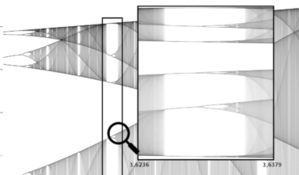
In t!r, !fluctuations always occur in series of 3 impulses (a 4th does not occur). Dynamics follow bifurcation diagrams (Feigenbaum Tree):
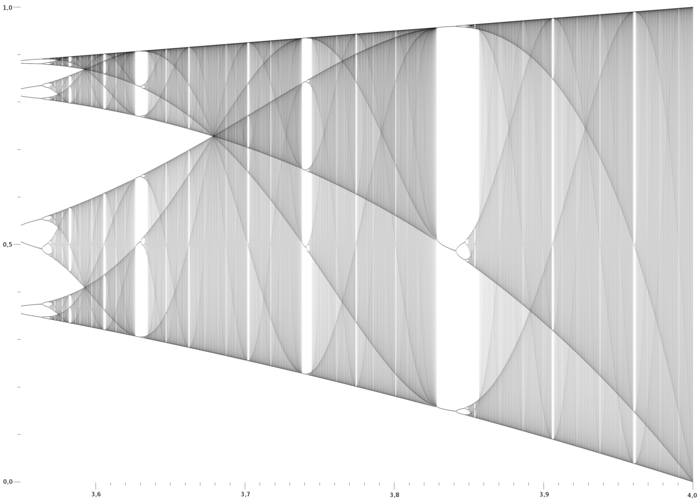
Period contraction: Time between 1st and 2nd !fluctuation is always longer than between 2nd and 3rd.
Feigenbaum ratio: Contraction follows universal constant δ ≈ 4.669.
Navigating !nonlinear bifurcation Points
System responses to 3-impulse !fluctuation cascades dictate future trajectory along !nonlinear bifurcation branches:
Synchronous vector: Consistent linear response keeps subsequent event !flow smooth and low-amplitude.
Divergent vector: Chaotic or contradictory response causes sharp directional changes and high instability.
8. Le Chatelier's Principle and Environmental Resistance
Le Chatelier's Principle Inside a !fluctuation Slot
In !libration points, systems undergo simultaneous internal (endocrine) shifts and external (environmental !fluctuation) impacts.
"Reality as Analogue LLM" Model
Humans act as tokens; events act as incoming transactions.
Reactive scenario: Automatic fear/aggression response creates recurring loops.
Proactive scenario (t!r tools): Analyzing past !time slot patterns enables conscious selection of new tactics.
Shifting !nonlinear bifurcation & Le Chatelier Effect
Choosing to shift a !nonlinear bifurcation (!nb) halts impulse transmission:
Transaction delay: Behavior pattern changes; transaction stalls.
Environmental pressure surge: Analogue LLM forces completion, increasing pressure.
Le Chatelier principle: Temporary resistance surge before equilibrium shifts.
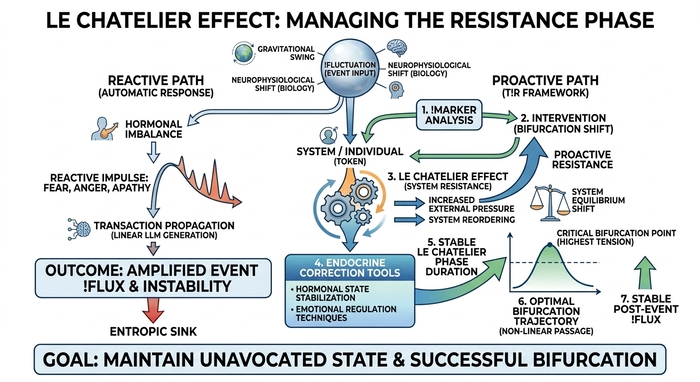
Le Chatelier Phase & Endocrine Management
Auxiliary self-regulation tools preserve stability during high-pressure phases: endocrine balance stabilization, emotional noise reduction, and smooth phase navigation.
9. Nonlinear Bifurcation and Event Cascades
!Nonlinear bifurcation (!nb)
Every cycle follows: !fluctuation → Le Chatelier → !nonlinear bifurcation.
3 !nonlinear bifurcation points exist per cycle, visible on Feigenbaum graphs.
The "Non-Choice" Phenomenon & Phase Reversal
Making a non-choice (shifting !nb) refuses transaction execution. Negative pressure spikes bounce into positive phase in the subsequent !time slot.
10. Event Flows and the Analogue LLM (aLLM) Concept
Event !flows viewed as macro Analogue LLM (aLLM) generation chains.
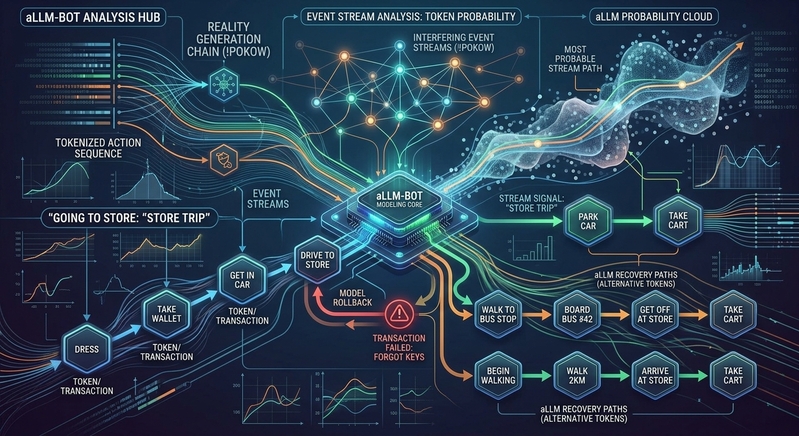
Transactions require strict sequential tokens. Missing tokens trigger model rollbacks and alternative path searches. aLLM bots calculate most probable runoff paths.
11. Event Flow Markers and Signatures
!Markers of Event !flow
Superposition of event !flow sine waves forms pseudo-tangent curves.
Nature & Role of !markers
Zero-impact signature elements registering event !flow frequency without destructive force.
| Parameter | Classical Forecast | Forecast via !markers |
|---|---|---|
| Methodology | General observation of entire option array | Point analysis of target event !flow chains |
| Computational Cost | High (redundant calculations) | Minimal (target trajectory calculations only) |
| Accuracy | Standard (high noise error) | Enhanced (via fractal signal registration) |
12. Cycle-3 as a Core Event Management Tool
Cycle-3 (OODA loop analogue in t!r)
!fluctuation → Le Chatelier → !nonlinear bifurcation
3-step decision algorithm for navigating !resonance slots during high uncertainty.
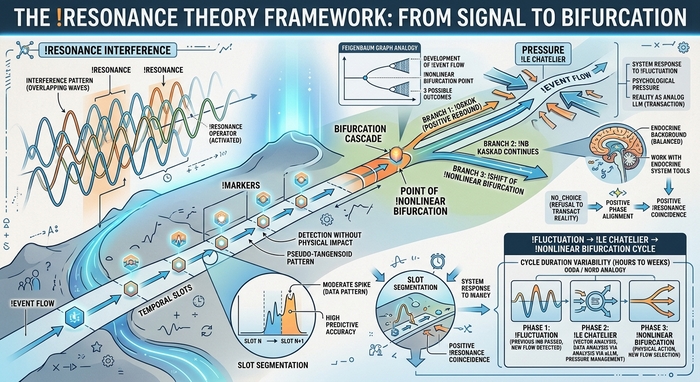
!Fluctuation (Primary Fixation Phase): Confirming previous !nb completion and new !flow formation.
Le Chatelier (Vector Analysis & Adaptation Phase): Identifying !flow vector under growing pressure.
!Nonlinear Bifurcation (Action & Switching Phase): Executing precise action/choice to switch event !flows.